
As we navigate through 2026, artificial intelligence has firmly established itself as the backbone of marketing practices worldwide. No longer a novel tool for experimentation, AI now integrates deeply into strategic frameworks, enabling brands to achieve unprecedented efficiency, personalization, and insight. According to recent reports, the AI in marketing market is projected to grow at a compound annual growth rate (CAGR) of 26.7% through 2034, reaching an estimated value of $217.33 billion. This growth is driven by advancements in agentic AI, hyper-personalization, and autonomous systems that allow marketers to focus on high-level creativity while AI handles execution. In this article, we delve into the key trends, technologies, challenges, and future implications of AI in marketing this year, drawing from industry insights and real-world applications.
The Emergence of Agentic AI as a Core Tool
Agentic AI—systems capable of autonomous decision-making and multi-step task execution—has become a game-changer in 2026. These AI agents go beyond simple automation; they orchestrate entire campaigns, from content generation to performance optimization, without constant human intervention. For instance, agencies are using agentic workflows to scale creative variations, test dozens of ad iterations, and adjust strategies in real-time based on market signals. This shift allows teams to automate routine tasks, freeing up resources for strategic oversight.
In practical terms, AI agents are now mediating purchase decisions, recommending brands through generative AI interfaces. Businesses are integrating these agents to reroute supply chains or pivot messaging amid disruptions, turning uncertainty into opportunity. A notable example from X discussions highlights how founders are building AI creative directors that replace traditional roles at major brands, handling everything from ad conceptualization to deployment. This trend underscores AI’s role in tying directly to performance metrics, reshaping operational models for better ROI.
Hyper-Personalization and AI-Driven Decision Intelligence
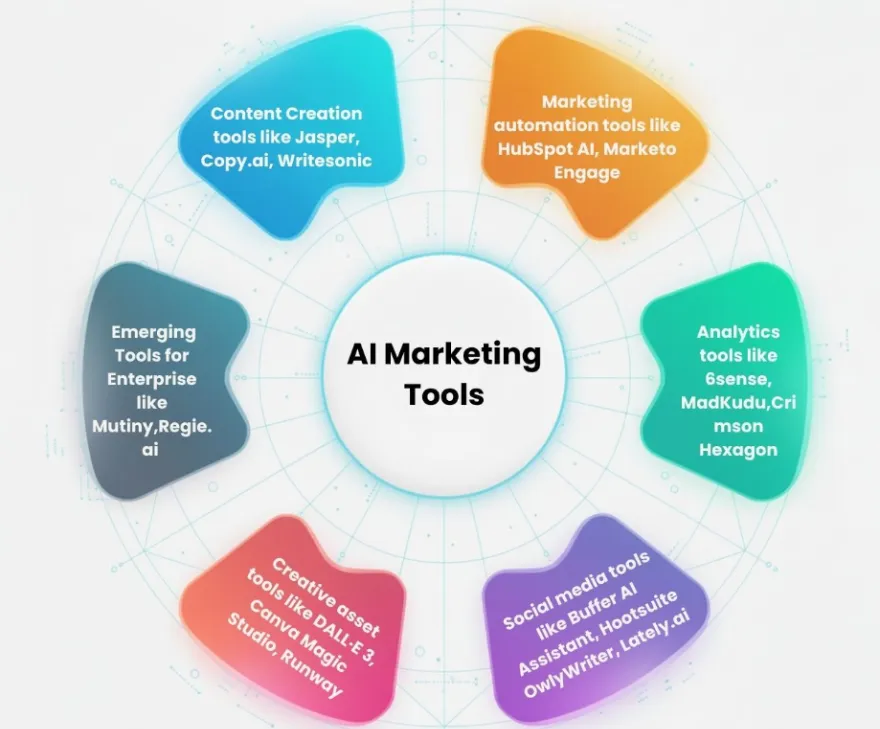
Hyper-personalization remains a cornerstone of AI in marketing this year, powered by advanced machine learning that analyzes vast datasets to predict consumer behaviors and deliver tailored experiences. Marketers agree that AI enhances personalization strategies, with 92% of businesses planning investments in generative AI to refine these efforts. Tools like AI copilots are now standard, assisting in building flows, testing variations, and scaling messages while maintaining a human touch.
Decision intelligence, another key trend, evolves AI from mere reporting to proactive recommendations. This includes predictive analytics for audience behavior and multimodal content creation that spans text, images, and videos. In 2026, AI is embedded in every stage of strategy, not just execution, helping brands connect with audiences through omnichannel integration and real-time adjustments. For example, machine learning for attribution and forecasting ensures marketers aren’t leaving money on the table, as noted in recent analyses.
Shifts in Search and Content Optimization
The search landscape has transformed with the rise of Generative Engine Optimization (GEO) and Answer Engine Optimization (AEO), moving beyond traditional SEO. In an era of zero-click and zero-visit searches, brands must optimize for AI-driven interfaces where answers appear directly in chatbots or assistants. This requires creating structured, machine-legible content that primes AI models with brand meaning, ensuring visibility in recommendations.
Content creation has also evolved, with generative AI producing blog posts, ad copy, and visuals at scale. However, this has led to a flood of “average” content, prompting marketers to differentiate through authenticity and bold messaging. AI-powered tools are aiding in engineering authority via EEAT (Experience, Expertise, Authoritativeness, Trustworthiness), crucial for standing out in algorithmic feeds.
Challenges: Balancing Authenticity, Mediocrity, and Ethics
Despite its benefits, AI in marketing faces hurdles. Generative AI is blurring lines of authenticity, leading to “slop”—mediocre output that trends toward the median. Marketers report that while AI makes content easier to create, it’s often less effective, with 52% noting reduced overall impact. This polarity encourages brands to push boundaries with button-pushing campaigns to capture attention.
Privacy and ethical concerns are paramount, with consumers demanding transparency in AI use. Over-reliance on AI risks diluting human creativity, so a balanced approach—combining AI’s speed with human judgment—is essential. Additionally, employee adoption is rising, but resilience requires sovereign AI systems to maintain control and trust.
Case Studies and Real-World Applications
Real-world examples illustrate AI’s impact. One X post describes building an AI monk influencer for a prayer app, running organic marketing across platforms without ads or teams—purely through AI-generated content and distribution. Another highlights structural shifts where AI handles campaign execution at scale, tying to ROI and operational efficiency. Agencies like those using HubSpot’s AI features are scaling workflows, building trust in crowded markets. In advertising, AI-driven search is reshaping brand connections, with platforms gravitating toward AI plug-and-play models.
Future Outlook: AI as Infrastructure for Growth
Looking ahead, AI will continue to transform businesses, with trends like autonomous orchestration and synthetic data driving innovation. By 2026’s end, expect wider adoption of AI agents for business transformation, emphasizing speed-to-value and community connection. Marketers who treat AI as infrastructure—integrating it for efficiency while preserving humanity—will lead the pack. As one expert notes, “AI will become every marketer’s copilot,” evolving quickly to handle heavy lifting and foster creativity.
In summary, AI in marketing in 2026 is about strategic integration, ethical balance, and innovative application. Brands that master these elements will not only enhance ROI but also build lasting